What Your Report Includes
The inspection scope, observed defects, likely failure modes, targets, limitations, recommended action and a timeframe for review or work.
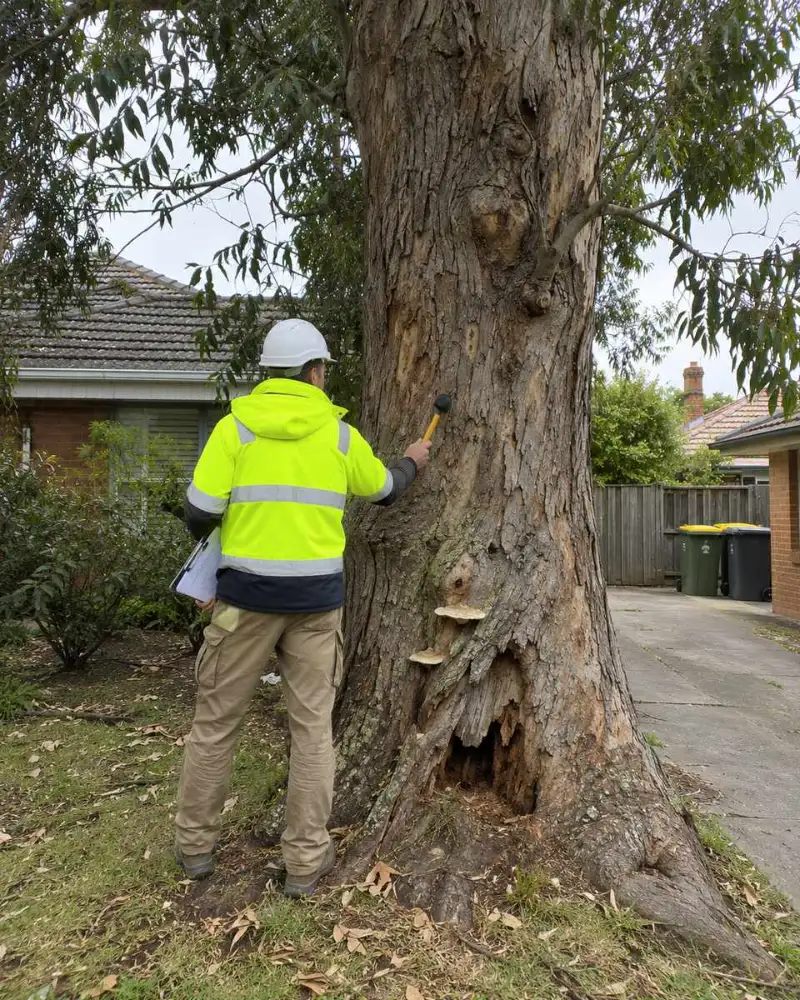
QTRA and TRAQ Assessments by AQF Level 5 Consulting Arborists
A tree risk assessment examines a tree's defects, what it could hit and the likely consequences, then recommends proportionate action. In Boroondara, a safety concern does not on its own remove the need for Council approval to remove a protected tree. Council decides whether an urgent approval or Authorised Officer direction applies, and our report provides the evidence.
Concerned about a leaning tree, decay, broken limbs or root movement near your home? We assess the risk and, where removal is justified and approved, carry out the work.
A visible defect does not by itself mean the tree will fail. The assessment evaluates the likelihood and consequences of failure.
Species, structure and defects inspected on site.
Targets and occupancy assessed: people, buildings, roads, services.
Likelihood and consequences of failure considered using QTRA or TRAQ.
Recommendations: monitoring, pruning, further testing, access controls or removal where justified.
The inspection scope, observed defects, likely failure modes, targets, limitations, recommended action and a timeframe for review or work.
Where a visual assessment can't resolve an important question, Resistograph decay testing or root investigation may be recommended.
We only recommend testing when it affects the decision.
Usually, yes.
Boroondara's Local Law requires a permit to remove a canopy tree even if it is dead or defective, and planning controls may also apply. A risk assessment provides the evidence Council needs; it does not itself authorise removal.
If a tree is moving, has partly failed or has hanging branches, keep people well clear and call us on 0493 993 187. We provide a 24/7 response for emergency tree work. If there is immediate danger to life, call 000.
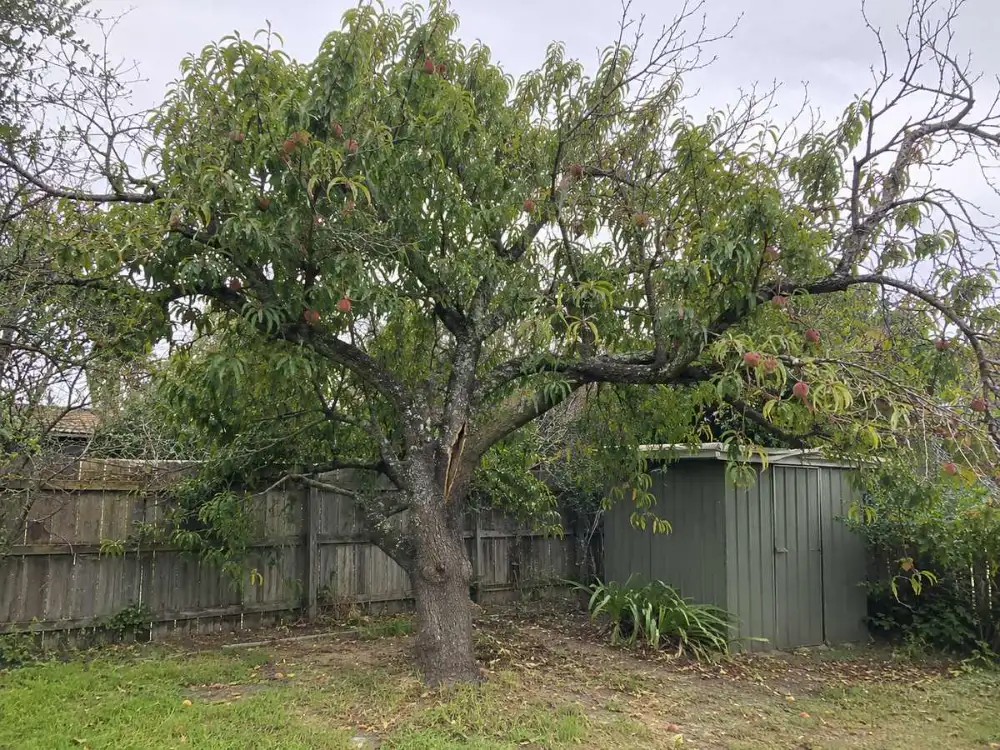 Illustrative image only. Not a photograph of this project.
Tree risk assessment of a mature Peach tree with upper-canopy dieback, decay around stem wounds and past poor pruning. Assigned low retention value and recommended for removal, subject to permit requirements.
Why it's relevant: tree condition and structural defects can support a removal application independently of proposed building works.
This summarises our report's recommendations. It does not claim a Council decision or completed works.
Our Boroondara reports are prepared by the Arbor Express consulting team, led by Robert de Jong, Principal Arborist (Diploma of Arboriculture, AQF Level 5; QTRA Qualified Practitioner; 32+ years in arboriculture). The team includes Director Alex de Jong (AQF Level 5) and arborists Matthew Bunting-Frame and Patrick Mortell. Each report names the arborist responsible for it. We also carry out professional tree removal and pruning. Fast-track refers to our report turnaround; Council assessment times are set by Council.
Google reviews from Arbor Express clients.
“Robert and Arbor Express were very helpful and professional in helping me deal with identifying a large dangerous tree which needed to be removed. I highly recommend Arbor Express.”
“Alex and his team helped me finalise my DA by doing root mapping and an arborist report. Alex exemplifies quality, and I loved his work so much I will have him as my project arborist for my build.”
“Thank you Arbor Express! Alex and Rob were able to deliver a high quality arborist report in a timely manner that received council approval. Would highly recommend!”
“Very quick, efficient and thorough. Arbor Express filed the report directly with our local Council, fees included, which meant we could have the dangerous tree removed within a week. Well worth the money.”
“Robert was easy to deal with, arrived at the appointed time and provided a completed report within days of the initial inspection. Excellent service.”
“I am very happy to provide a review of Arbor Express. I was very happy with Robert’s work and the comprehensive report he provided. Thank you Robert and team.”
“Very quick and professional service. They even offered to provide a report over the Easter holiday, so impressive commitment to customer service.”
“Arbor Express provides professional reports and follow up advice. Their friendly attitude makes understanding the process regarding neighbourhood disputes easy. Highly recommend”
“A complex matter involving several large council-owned gum trees adjacent to my property … his advice was balanced and evidence-based, and the report was not exaggerated or one-sided.”
Warning signs include new cracks or splits in the trunk or major branch unions, fungal growths at the base, soil heaving or lifting around the roots, a lean that has recently changed, large dead limbs and cavities. Many serious defects are internal, so only an inspection can assess the risk. If the tree is moving or the soil is lifting, keep people clear and call us immediately.
A tree risk assessment evaluates how likely a tree or branch is to fail, what it would strike, and the likely consequences. Our AQF Level 5 consulting arborists use QTRA (Quantified Tree Risk Assessment), which expresses risk numerically against accepted thresholds. Recommendations are then proportionate to the actual risk rather than based on how the tree looks.
No. Many trees with defects can be safely retained through targeted pruning, crown reduction, cabling, monitoring or changes to how the area beneath is used. Where risk can be reduced to an acceptable level, retention is often the recommended outcome. Removal is recommended only when reasonable alternatives cannot adequately manage the risk.
Not if it is protected, unless Council authorises it. Keep people clear of a moving, splitting or unstable tree. For immediate danger to life, call 000. If the tree is protected, contact Council urgently about the approval or Authorised Officer direction required. We can assess and document the hazard where it is safe to do so. A planning exemption does not automatically remove Local Law requirements. Removing a protected tree without the required approval can lead to penalties.
A strong application documents the tree’s species and measurements, identified defects, the people or property at risk, likelihood and consequences of failure, and photographs. Diagnostic findings such as Resistograph testing should be included where relevant. It should also explain why pruning or other management would not adequately reduce the risk. Our AQF Level 5 reports address each of these, although Council makes the final decision.
Photos help us understand the site, judge urgency and quote accurately. They cannot confirm internal decay, root stability or the true extent of a defect. A formal risk assessment or Council report requires a site inspection, and diagnostic testing where appropriate.
Responsibility for a tree generally rests with the property where it grows. An independent arborist assessment gives you objective evidence to discuss with your neighbour, rather than a difference of opinion. If the tree is on Council land or a nature strip, report it to Boroondara Council directly. We provide arboricultural evidence, not legal advice.
Send the property address and photos, or call to arrange a tree risk assessment.